Following is a video covering the delightful 2011 Sorghum harvest and molasses making in Lunenburg that occurred in the last days of September. Several Lunenburg families joined in to make memories come alive by cultivating cane plots, helping in the harvest, providing various equipment and livestock, and processing the sorghum cane into sweet Ozark molasses! Thanks to the Teague and Tate families along with all others who helped make this amazing cultural event happen!
ENJOY!
Showing posts with label Lunenburg. Show all posts
Showing posts with label Lunenburg. Show all posts
Thursday, November 24, 2011


Thursday, August 04, 2011
A History of Izard County: The Civil War
While perusing Karr Shannon's book, A History of Izard County, last week for his writings about Lunenburg and the people who lived there, I was side-tracked by the author's avoidance of details about the American Civil War. As I looked for items about the skirmish that occurred along Rocky Bayou in January of 1864, I noticed that little information about any part of the conflict was offered to the reader. The most significant item I found about the Civil War and Lunenburg throughout the 1947 book was Karr's depiction of the "stranger" who was accidentally hung and then "buried in a grave from which a northerner had been exhumed a short time before." (Karr Shannon)
Mr. Shannon actually begins his comments in the chapter, "Izard County and Wars" with a description of the area as serene and peaceful having little conflict throughout it's history:
For instance - Surely Karr knew about the Byler family. Surely he knew about the plight of Judge William L. Byler and his family.
In the October 1982 edition of The Izard County Historian, (Volume 13 Number 4, Edgar D. Byler III writes:
Edgar D. Byler says further of the family:
Edgar Byler goes on:
As is the story of the Dixon brothers.
Owen and Ruth Dixon along with Frances Thompson write in their excellent work on the Matthew Dixon Family:
The group also writes in the Matthew Dixon Family article about "Uncle Brushy's" brother, Hilliard:
While avoiding the conflicts among Izard County's families Karr also fails to mention the Mill Creek Peace Oraganization Society, an affiliate of the Arkansas Peace Organization Society , an organization of people against the war and not willing to fight for either side. These were families that worked together for self-preservation in the midst of the conflict. They just wanted to live their lives in peace without having to choose sides against their neighbor.
However, there were men in Izard County at the time who complied and even enforced Governor Rector's order to round these people up. They were forced via threats of execution to join the Confederacy.
This certainly deserved to have been mentioned by Karr Shannon in his A History of Izard County. The subject deserved more than his suggestion that a few men were opposed to the war early on but eventually joined the confederacy on their own.
There were some men actually executed!
Why would Karr Shannon, journalist, historian, faithful lover of Izard County, have left these things out? I believe it was because of the very same thing historians have to deal with every day. It's certainly something I have had to deal with concerning the way I approach writing about some of the events that have occurred in Izard County. There are still piercing sensitivities about certain events in our county's history.Those sensitivities are ignored at the peril of the writer.
Ironically, one event I have not had the freedom to write about is the very event I believe motivated Karr Shannon to write his 1947 work on the history of his beloved Izard, the Murder of Sheriff James Lawrence Harber and the trial of Rubert Byler that followed. The Izard County community was sharply divided about the event surrounding the tragedy back when it happened and those divisions and perceptions still exist today! The slightest indication of taking sides one way or another can and do result in rebukes from those who still have those sensitivities.
This is why I think Karr's coverage of the Civil-War in Izard County was so obscure and even sugar-coated a bit. The children who were affected by the War Between the States were the leaders during the time Karr grew up in Lunenburg. Likely, many of the resentments among family members and between citizens still existed. Perhaps it was not a lack of knowledge about the events that occurred only a few short decades before. Perhaps it was his writer sensitivity.
Mr. Shannon actually begins his comments in the chapter, "Izard County and Wars" with a description of the area as serene and peaceful having little conflict throughout it's history:
"We appreciate the fact that the history of Izard County does not have to deal with downfalls and uprisings of any vaunted civilization. This has never been a section of conflicts. The people have been intelligent, kind, and hospitable. Scarcely any murders have been committed throughout the entire history of the county. It is enough for us to know that our forefathers were human beings - they lived and acted their parts, and all they did contributed to everything that now prevails. They were here first and did their work as human beings unmanacled by prejudice and disagreement."After his apology for Izard County's citiizens throughout its history, Karr goes on to write an apology for an Izard County that embraced slavery:
"It would be useless to go into detail here and tell about the cause of the Civil War. Nothing needs to be said about the conventions held in the South for the purpose of discussing the question of secession. Arkansas happened to be located in the Southland, and Izard County happened to be located in Arkansas. Negro Slaves were needed in the hot fields, and, like other sections of the South, Izard County used its share of these people. There is no room here for discussing the question of slavery. As environment must have its course, the people of Izard County gave very little thought to the question of whether it was right or wrong to use negro slaves. The rest of the South used slaves, and Izard County used slaves."Shannon's reasoning here was sound, if not a little blunt. However, this is truly an apology for the actions of the earlier pioneers of the county. His remarks on the Civil War continue:
The war in Izard County probably was not quite as bloody as other places but it seems that Karr sugar-coated his remarks about the conflict in this area of the country in general. It wasn't likely to be because of ignorance on Karr Shannon's part, though, because his own writings tell us that as a youngster in Lunenburg, he frequently hung around the stores and blacksmith shops listening to the old-timers swapping stories. As he was born only 37 years after the end of the Civil-War, it's highly probable that some of those conversations, at least, were about Civil-War experiences. Karr Shannon was an avid reader and observer all of his life. If there were stories told, he probably remembered them. He was a newsman...a teacher...a historian. One would think he would have gone into more detail about how the war affected the lives of family and family friends."Several companies of soldiers were raised within the county for service in the Confederate Army. One, gathered by Captain Deason, served in the Seventh Arkansas Regiment. Four, commanded respectively by Capts. C. C. Elkins, T. N. Smith, Hugh A. Barnett and T. A. Mason, became a part of the Ninth Arkansas Regiment. Two, commanded respectively by Capts. C.Cook and Richard Powell, served in Colonel Freeman's regiment of cavalry. Three, commanded respectively by capts. T. M. Gibson, R. C. Matthews and Samuel Taylor, formed a part of Shaler's regiment. Also a portion of the company was raised in Independence County. A part of another was raised by Capt. James Huddleston, the other part being recruited in what is now Sharp County. Some individuals went out and joined other companies being established for the Southern Army.
"At the beginning of the war there were several Union men in the county. They left the county and went to Rolla, Missouri, where they were organized into a company by Capt. L. D. Toney and served in the Federal army. Izard was very faithful to the cause. All the able-bodied men in the county and many boys under twenty years of age enlisted in the armies. Only the old, the feeble, and the invalids were left at home with the women and children.
"There was no fighting or bushwhacking among the citizens on Izard County soil, but the county was frequently overrun by scouting parties from the opposing forces and all stock and provisions carried away. This caused suffering among the citizens for food. It is said that parties of women, each accompanied by an old man, frequently hauled cotton inside the Union lines and exchanged it for salt and other necessities.
"Conditions became so severe that meat had to be concealed from the scouting parties by hiding it in straw beds, under brush heaps, and in piles of rocks. Some saved their corn by shelling it and hiding it in the hollow walls of houses between the weatherboarding and the inside-boarding. A hole at the bottom served the convenience of drawing out the grain as it was needed. Salt became a luxury. Many dug up the dirt in their smokehouses and boiled out the salt. Bed clothes and other garments were sometimes carried off by the scouting parties and burned in the woods."But the destructive effects of the war in Izard County were far short of what they were in a number of other sections of the South where actual battles were fought and hundreds in their youthful prime were shot down."

For instance - Surely Karr knew about the Byler family. Surely he knew about the plight of Judge William L. Byler and his family.
In the October 1982 edition of The Izard County Historian, (Volume 13 Number 4, Edgar D. Byler III writes:
"Between 1850 and 1861, William L. Byler amassed a large amount of land in the Sage area of Izard. During the War of Rebellion, he elected to remain loyal to the Union. He was warned that he should leave the county or be imprisoned. He and his brother-in-law, Shadrach H. Wren, packed up all their belongings and moved to Rolla, Missouri for the duration of the War. William’s lands were confiscated by the Con-federate government and never recovered. When he returned to Izard in 1865, he was able to buy back his original homestead south of Sage.If this did not deserve mention on its own, perhaps combined with the biographies of Williams only two brothers living at the time, it would have.
"From 1868 to 1874, William L. Byler served as County Judge of Izard County and also as Probate Judge. It is not known whether he was appointed by the military governor of Arkansas or was elected. Further research is needed in this area."
Edgar D. Byler says further of the family:
"John Adkinson Byler was born 26 February 1828 in Bedford County, Tennessee. He married on 17 April 1855 in Izard County to Mahala Rose, who was born in Tennessee in 1836. John A. Byler served in Company F, of Colonel Freeman’s Regiment, Confederate Army from 1 September 1861 until the close of the war. He is buried in the Lunenburg Cemetery. John and Mahala Rose Byler were the parents of eight children:..."It is entirely possible that John A. Byler was a participant in the action in Cooper Valley near Lunenburg!
Edgar Byler goes on:
"Joseph Love Byler was born 1 October 1834 in Bedford County, Tennessee. He married in 1854 to Rachel R. Gray, the daughter of John and Elizabeth Chism Gray."
* * * * * *
"According to Goodspeed’s History of Northeast Arkansas, Joseph L. Byler “served in the Confederate Army under Captain Gibson and Col. Shaler from 1861 to 1865, being in the infantry and was a participant in a number of battles.” He owned a mill and cotton gin at Lunenberg and also ran a “mercantile establishment.” In 1888, Joseph L. Byler became postmaster at Adler, and in 1903 was appointed postmaster at Guion."William L. Byler, future County Judge, was run out of the county and had his land stolen from him. His brothers were his enemy. That is worthy of mention.
As is the story of the Dixon brothers.
Owen and Ruth Dixon along with Frances Thompson write in their excellent work on the Matthew Dixon Family:
John "Brushy" Dixon

"John B. Dixon, better known as “Brushy”, was a farmer, wagon and cabinet maker, in all of which occupations - as well as with the fiddle and bow - he ranked in a class by himself. It mattered not what “Uncle Brushy” undertook to do; he accomplished it highly satisfactorily to all concerned.
"Soon after coming to Arkansas, he built a wagon shop at his home and began to build the wood work of wagons, while Jim Cooper, a black-smith, did the iron work for him. And so well finished and substantially constructed was his product that he was depended upon to make wagons for the people of the entire community. He would go to the woods and personally select his timber, cut and split it, haul it to the shop and let it season at least one year before using it in his wagon work. He entered 240 acres of land at $1.25 an acre, and he and his children opened up a nice little farm. Most all his children, both boys and girls, played the violin - some very efficiently. His home was 3 miles west from where Melbourne now is. He was one of the fiddlers supplying music for dances at the Centennial celebration held at Newburg, July 4, 1876.
"At the outbreak of the Civil War, his sympathies being with the Union, he and his family were treated somewhat of contempt by most of the people in that country. They stole his stock, and even threatened his life. His father let him have his horse one year to make a crop. To keep it from being stolen, they kept it hidden of nights in a pine thicket. One evening, Amanda went out to feed the horse and came upon two men just ready to take it away. She grabbed the reins and was in the act of mounting the horse when they overpowered her and took it. Threats against Brushy’s life forced him to stay hidden every night. One night however, he slipped in home to spend an hour or two with his family, when two men entered to take him away. A general fight ensued - most of the girls being well grown and strong, they succeeded in driving the intruders off. They then decided, for their protection, to refugee to Missouri, near Rolla, where was stationed a Union fort. Uncle Brushy went on ahead to make preparations for the family, they following in ox-drawn wagons. The wagons being filled with household goods, the family had to walk. Within a few miles of their destination, the oxen gave out. Driving them off the road a short way, they stopped. The oxen lay down and died. Two of the girls walked on to the Fort to secure aid to take them on. A detachment was sent after them - their father going with them when they were taken to their destination. The next year the war closed and they returned to their home.
"A year or so later, Uncle Brushy was elected Justice of the Peace, his Court being held in his home. Thus, this house - now standing, was the first house where law and order were meted out since some time before, and during the war. Wm. C. Dixon kept the records for him."There was conflict among the citizens of Izard County. That cannot be erased away. People were treated brutally for their loyalty to the nation of their birth. Even among families, loyalties cut deep.
The group also writes in the Matthew Dixon Family article about "Uncle Brushy's" brother, Hilliard:
"Hilliard Dixon - farmer and country school teacher - was a plain, unassuming, inoffensive man of rather reserved and passive disposition, small in stature - approaching the effeminate - yet with all strong and determined in favor of the right as he saw it. Against secession from principle, he believed and advocated the perpetuation of the Union. Yet, when his adopted state declared in favor of secession five of his sons, with his hearty approval went forth to battle for the cause of the South."
While avoiding the conflicts among Izard County's families Karr also fails to mention the Mill Creek Peace Oraganization Society, an affiliate of the Arkansas Peace Organization Society , an organization of people against the war and not willing to fight for either side. These were families that worked together for self-preservation in the midst of the conflict. They just wanted to live their lives in peace without having to choose sides against their neighbor.
However, there were men in Izard County at the time who complied and even enforced Governor Rector's order to round these people up. They were forced via threats of execution to join the Confederacy.
This certainly deserved to have been mentioned by Karr Shannon in his A History of Izard County. The subject deserved more than his suggestion that a few men were opposed to the war early on but eventually joined the confederacy on their own.
There were some men actually executed!
Why would Karr Shannon, journalist, historian, faithful lover of Izard County, have left these things out? I believe it was because of the very same thing historians have to deal with every day. It's certainly something I have had to deal with concerning the way I approach writing about some of the events that have occurred in Izard County. There are still piercing sensitivities about certain events in our county's history.Those sensitivities are ignored at the peril of the writer.
Ironically, one event I have not had the freedom to write about is the very event I believe motivated Karr Shannon to write his 1947 work on the history of his beloved Izard, the Murder of Sheriff James Lawrence Harber and the trial of Rubert Byler that followed. The Izard County community was sharply divided about the event surrounding the tragedy back when it happened and those divisions and perceptions still exist today! The slightest indication of taking sides one way or another can and do result in rebukes from those who still have those sensitivities.
This is why I think Karr's coverage of the Civil-War in Izard County was so obscure and even sugar-coated a bit. The children who were affected by the War Between the States were the leaders during the time Karr grew up in Lunenburg. Likely, many of the resentments among family members and between citizens still existed. Perhaps it was not a lack of knowledge about the events that occurred only a few short decades before. Perhaps it was his writer sensitivity.
Thursday, July 28, 2011
A History of Izard County: Lunenburg
 |
| Old Lunenburg School - Courtesy, Jennifer McSparren |
It's appropriate that we first take a look at his intimate connection with the Lunenburg community before getting into his writings about the places and people of his childhood home. A couple of paragraphs from Shannon Roe's excellent biographical article about Karr in The Encyclopedia of Arkansas History and Culture does this best:
"Born on March 1, 1902, at Lunenburg (Izard County), Karr Shannon was the only child of farmers Robert Nathan and Allie Maud (Estes) Shannon. A bout with scarlet fever and measles at age three left Shannon with only thirty percent of normal hearing. When he was five, his mother died of tuberculosis, and his father moved to New Mexico, where he, too, died of tuberculosis three years later. Shannon stayed behind in Lunenburg with his widowed aunt, Lucy Estes Horton, who took him to live with her and her grandfather, Thomas Estes.
"As a child, Shannon divided his time between farm work and Lunenburg’s one-room school through eighth grade. He completed high school in Melbourne (Izard County) and junior college at Mountain Home Academy and College in Baxter County. He then studied pharmacy at Little Rock College, became a licensed pharmacist in 1924, and worked at Mac Curlee’s drug store in Mountain Home until he developed allergies to pharmaceutical chemicals.
Following his brief stint as a pharmacist, Shannon passed the state teachers’ exam and taught school at Franklin (Izard County) and Melbourne, where he also served as principal. In 1926, he became Izard County superintendent of schools at the age of twenty-four."
In the January, 1973 issue of the Izard County Historian (Volume 4 Number 1), Karr Shannon's widow, Ollie Fudge Shannon (also known as Mrs. Karr) wrote:
"Shannon lived at Lunenburg until he was 18 years of age. During his early childhood, he suffered every childhood disease known -having measles, whooping cough, and typhoid fever the same year. Either disease might have been enough to kill any small child, however, he survived. His numerous bouts with disease left his hearing impaired for life. He often said this "was an asset." It enabled him to read and concentrate with people talking all around him. He loved to read and during his last years read constantly. I'm sure he read 200 or more books during his last year."
 | |
| Karr Shannon at "Poss" Haley's Store |
"I remember the old blacksmith shop at Lunenburg. The bellows for the forge were of the most antiquated pattern, badly worn, ponderous, working with a groan at every move -sounding like some huge animal dying in agony. The bellows leaked mysteriously so that faster pumping was required to put the white heat into the metal on the forge.
"The village smithy was usually a fair carpenter. He made a specialty of building coffins for the demise of families too poor to invest in a store-bought container. During my sojourn in Izard County I patronized eight different blacksmiths and never did business with one who was not strictly honest. I never knew one who over-charged. As a boy, I spent many an hour around the old shop, waiting for plowpoints to be sharpened, waiting for a horse to be shod, or just enjoying the pastime of watching the sparks fly from the anvil. There was a time when there possibly were 20 to 25 blacksmith shops in Izard County, at least one for just about every town and hamlet. I wonder how many are in operation today."Karr Shannon clearly adored Lunenburg and treasured his childhood there. Another disappointment with his 1947 book, A History of Izard County, however, is the lack of details about the history of this little community Perhaps, again, it can be attributed to his overlying purpose in writing the book which was to paint the area as normal and progressive on the heels of bad publicity. It appears that a lot of history was omitted in his effort.
Following are the passages about Lunenburg from Karr's 1947 work:
The Place
"Lunenburg is an old settlement. It was a pretty fair town for several years before the Civil War, but a post office was not established there until February 3, 1868. Robert R. Case was the first postmaster. The office was discontinued May 12, 1868. Exactly two years later, it was re-established with John Carney as postmaster. It was again discontinued Novemeber 8, 1872. It was re-established August 11, 1873, with Harvey R. Landers as postmaster. The office played out again April 9, 1883, but resumed permanent operation April 13, 1891, with William G. Cypert as postmaster.
"When the post office was established the first time, the question of a name came up. There was already a general store in operation. The merchant, "Bob" Case, asked a group of loafers what to name the post office. An old German man, who liked his "dram," was pretty well organized at the time, and probably seeing visions of his old town left behind said: "Call her Lunenburg, by God!"
"Mrs. Zelda Banning is the present postmaster . NOTE - The post -office was finally discontinued July 31, 1955
" A school building, with a lodge hall upstairs, was built shortly after the close of the Civil War and remained in use for school purposes until a few years ago when the district built a new stone building. The old school building is now used as a church house by the Baptists. The school bell which is still in use is said to be the first bell ever brought to the county.
"The Rocky Bayou Baptist Association, still active and growing over a large area, had its birth here over 100 years ago. NOTE - The Rocky Bayou Baptist Association is still in existence.
The People
"Mack Cypert, for many years surveyor of Izard County, was born in the Hidden Creek area, near Luinenburg. After complete\ing courses in the common schools, he attended the Lacrosse Collegiate Institute for two years. He attended the Southwest Texas State Normal, San Marcos, Texas, in 1915-16. He taught school a total of about 30 years. He first became surveyor of the county in 1906, and served at intervals for years, being in this capacity at the time of his death January 19, 1931.
"Mr. Cypert was well read and a pretty good authority on most anything. He was a good stenographer, well versed in both law and engineering, and once wrote a song which sold well as sheet music. He never married.
* * * * *
" E.G. Landers, one of the pioneer merchants of Izard County, was born in Tennessee May 7, 1846, and came with his parents to Arkansas in 1854. He began operating a cotton gin at Lunenburg at the age of 22 and also followed the carpenter's trade for some time. In 1864 he joined the Confederate army, remaining about a year when he surrendered at Jacksonport, Arkansas.
" After the close of the war, he returned to Lunenburg and in 1877 engaged in the mercantile business there. In 1880 he established a business in Melbourne known by the firm name of Landers & Company. The business is still being operated, and is the oldest established mercantile business in the county. Mr. Landers was also interested in farming and livestock and had considerable real estate holdings when he died April 10, 1927.
" Associated with E.G. Landers in business for many years was his son, J. Hayden Landers, who was born at Lunenburg March 12, 1881. He entered the mercantile business with his father in 1901. He operated the store until his death in November, 1946. The latter Mr. Landers was also an extensive landowner and interested in fine livestock. He was an official in the Bank of Melbourne for years, chairman of the board of deacons of the Melbourne Baptist Church for 20 years, and was a member of the various boards connected with civic and agricultural improvements. His widow lives at Melbourne and his two sons, Earl Landers and Dr. Gardner Landers, live at Batesville. Dr. Landers was a colonel in the last World War."
Thus is basically the sum total of Shannon's remarks about his childhood home in A History of Izard County. One must wonder why he didn't at least mention the skirmish that took place here in January of 1864. Especially since he does mention the following:
"Shortly after the Civil War a resident of near Lunenburg, a Mr. Nail, had been robbed of a considerable amount of money. At about the same time, a suspicious stranger appeared at the town. A group of citizens, some of whom were later prominent in the business and professional affairs of the county, according to a story that was familiar years ago, took the stranger in custody for the purpose of questioning him. He proved to be a stubborn and uncommunicative chap. As an inducement toward supplying wanted information a rope was placed about his neck and passed over a limb of a sycamore tree. It would be drawn tight so that the stranger's toes would barely touch the ground and at his signal would be relaxed, but on each occasion he would refuse to talk. It was decided to scare the man into loquaciousness. But the questioners miscalculated their strength and the man's neck was snapped. He was buried in a grave from which a northerner had been exhumed a short time before. No investigation or arrest was ever made."The open grave where the stranger was buried was the one in which Asa.A. Williams of the 4th Arkansas Mounted Infantry was buried after being slain during the Lunenburg Skirmish, January 20th, 1864. It was the Williams family who exhumed his body and contrary the passage above, was not from the North but from Arkansas.
We'll be sticking to the theme of Lunenburg over the next week on the blog. This weekend, we'll quote other sources and share more information about Lunenburg. For a mid-week post next week, we'll learn about Karr Shannon's remarks on the Civil War in Izard County and discuss them as well.
Photo of Karr Shannon at "Poss" Haley's Store from October 1976 issue of Izard County Historian (Volume 7 Number 4)
Tuesday, May 10, 2011
Video: Pioneer Day traverse 2011
Below are clips we gathered over Pioneer Day weekend. Tony McGuffey and his wife, Roberta, joined us on Saturday for a personal tour of some of the sites in the western part of Izard County.
ENJOY!
ENJOY!
Wednesday, January 19, 2011
Video: 2010 Fall Round-Up Part 2
Tech for You! Click Here to download software that will allow you to download any video on YouTube as an MP4 or MP3!
Tuesday, September 28, 2010
Old Lunenburg Saloon: Dismantled, Moved!


On Saturday, September 25th, a group of around a dozen hearty individuals with a desire to see one of Izard County's historical treasures preserved met at the site of the Old Lunenburg Saloon to dismantle the old relic and move it to the grounds of the Lunenburg Community Center where it will be rebuilt and restored. For many years, people have talked about the need to preserve this important piece of Izard County's history and culture and on Saturday, a very big step was taken to finally follow through on the talk. Although the task of actually getting the building moved has now been accomplished, the hard work lies ahead as the logs are to be repaired, replaced, and preserved before the work begins on reconstruction.
While the repairs are being made and replacement logs sought, the Lunenburg Community Center Association will begin raising money to pour a concrete slab which the Saloon will eventually rest upon, buy the materials for the authentic cedar-shake roof, for period-style furnishings, and for any other costs created by the project...including upkeep of the building.
We hope you or your business will support this effort to preserve Izard County's history by donating to the Lunenburg Community Center Association. You can do so by contacting Roger Harvell at:
870-368-3618
or via e-mail at:
rogerh48@earthlink.net
Video Coming Soon!


Monday, September 20, 2010
Tagging the Tavern
Video Below!

It is unknown exactly when the old Lunenburg Saloon was erected. The town itself, originally called "Rocky Bayou" can be dated to at least 1820 and legend has it that the opening of the tavern occurred soon after the first business, a trading post, began operation.
Because of its early importance to the Izard County community, it is imperative that this unique structure is preserved. That's why The Lunenburg Community Center Association along with EIC has decided to dismantle the old relic which was donated by its current owners, Will and Pam Willbanks, and relocate it on the grounds of the existing Lunenburg Community Center (The old Lunenburg Schoolhou se).
se).
This weekend, Jim, Bo, and I along with Roger Harvell prepared the building for dismantling by tagging the logs for reference when it is re-erected at it's new site. The logs will be stored until we can clean them all, restore those that need restoration, and repl ace those that cannot be salvaged. Once repairs have been made and replacements fashioned, a slab will be poured and the building will be restored complete with a period cedar-shake roof. The building will be moved on Saturday, September 25th, 2010.
EIC is proud to be a part of this important project and hopes that the community will get involved as well by helping the Lunenburg Community Association fund the project through donations and sponsorships.
If you would like to help us dismantle and move the saloon, join us at 7 AM next Saturday at the old Smith-Tate home near the bridge at Lunenburg!

It is unknown exactly when the old Lunenburg Saloon was erected. The town itself, originally called "Rocky Bayou" can be dated to at least 1820 and legend has it that the opening of the tavern occurred soon after the first business, a trading post, began operation.

Because of its early importance to the Izard County community, it is imperative that this unique structure is preserved. That's why The Lunenburg Community Center Association along with EIC has decided to dismantle the old relic which was donated by its current owners, Will and Pam Willbanks, and relocate it on the grounds of the existing Lunenburg Community Center (The old Lunenburg Schoolhou
 se).
se).This weekend, Jim, Bo, and I along with Roger Harvell prepared the building for dismantling by tagging the logs for reference when it is re-erected at it's new site. The logs will be stored until we can clean them all, restore those that need restoration, and repl
 ace those that cannot be salvaged. Once repairs have been made and replacements fashioned, a slab will be poured and the building will be restored complete with a period cedar-shake roof. The building will be moved on Saturday, September 25th, 2010.
EIC is proud to be a part of this important project and hopes that the community will get involved as well by helping the Lunenburg
 Community Association fund the project through donations and sponsorships.
If you would like to help us dismantle and move the saloon, join us at 7 AM next Saturday at the old Smith-Tate home near the bridge at Lunenburg!
Sunday, August 08, 2010
Save the Saloon!

A Reminder that we'll be having our second meeting to plan the moving of the Old Lunenburg Saloon from near the old Smith-Tate home to its new location on the Lunenburg Community Center grounds.
We'll be setting up committees and need all the help and skills we can get!
Join us at the Lunenburg Community Center tomorrow night, August 10th, at 6PM!
Let's save this important historic building, Izard County's first saloon!
NOTE
We promised our e-mail subscribers an article covering our awesome journey as we've built Exploring Izard County this weekend. We're sorry to say that we'll miss our deadline but want you to know the article is in the works and will be worth the read once it's published sometime over the next couple of days! Stay Tuned!
Saturday, July 17, 2010
Video: Skirmish at Lunenburg
New Photos Below!

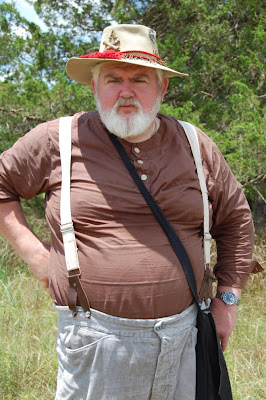


All Photos by Cecily Elrod
Civil-War Camp Video Coming Soon! More Photos to Come!


All Photos by Cecily Elrod
Civil-War Camp Video Coming Soon! More Photos to Come!
Saturday, July 10, 2010
Ready to Rumble?
Civil-War Re-Enactment Today at Lunenburg!
UPDATE! New Photos from Day 1 added below!
UPDATE 2 ! Video Added!
If you're looking for something to do today or tomorrow, you need look no further! Join us at Lunenburg today and tomorrow for the first-ever Civil-War re-enactment in the county. The event will commemorate the January 1864 Skirmish at Lunenburg when T.A. Baxter led a Union patrol through Izard County and encountered a large group of Confederates under the command of Colonel Freeman of Freeman's Regiment. The running battle took place along Rocky Bayou and Cooper Valley.
Several re-enactment units from Arkansas and Missouri have set-up camp at the Old Lunenburg Schoolhouse and will be performing the re-enactments at 2PM on Saturday and 1PM on Sunday!
The event is free to the public so grab your friends and family and come out to witness this unique event that we hope becomes a tradition for Izard County!
Following are photos from the camp as the groups began arriving and setting up along with more photos from Saturday's performance.


Wednesday, June 09, 2010
New Historical Marker at Lunenburg!

This is the new Historical Marker recently placed in front of the Lunenburg Community Center commemorating the January 1864 skirmish that took place along Rocky Bayou.
Click Image to Enlarge.
Monday, April 19, 2010
Civil-War Re-Enactment Near Melbourne (Pioneer Day)
The Seventh Arkansas Volunteer Infantry will bring to life the Battle of Lunenburg on Saturday, May 1st at 3:00 p.m. The public is invited to the recreation of the battle in the same farm field south of Melbourne where the 1864 battle was fought. Led by their color guards, Confederate and Union re-enactors in authentic uniforms will take up positions as five full size cannons take the field. A second re-enactment is planned for Sunday, May 2nd at 2:00 p.m.
The Izard County Historical and Genealogical Society and the Arkansas Civil War Sesquicentennial Historical Marker Program are placing a plaque commemorating the battle on the grounds of the Lunenburg Community Center. This plaque will be unveiled on Saturday at 5:00 p.m. after the re-enactment. The text of the plaque reads:
“On January 20, 1864, a detail of 44 men of the Fourth Arkansas Mounted Infantry Volunteers (U.S.) under Capt. T. A. Baxter, the brother of a future Arkansas governor, attacked Col. T. R. Freeman’s Confederates, driving them from their camp at Lunenburg. Four Confederates were seriously wounded and two were captured, along with horses and equipment. The Fourth Arkansas lost one man killed in the skirmish. The combat at Lunenburg illustrates the war’s true nature: Most of the men in both forces were residents of Izard County.”
The Izard County Historical and Genealogical Society is raising $1,000 in matching funds for the plaque. Contributions can be sent to ICHGS, PO Box 306, Pineville, AR 72566. To watch the battle of Lunenburg, take Highway 9 southwest from Melbourne, turn left on Country Road 3, drive back three and a half miles to the Community Center. For more information, contact Historical Society President Roger Harvell at 870-368-3618 or mailto:rogerh48@earthlink.net
The Izard County Historical and Genealogical Society and the Arkansas Civil War Sesquicentennial Historical Marker Program are placing a plaque commemorating the battle on the grounds of the Lunenburg Community Center. This plaque will be unveiled on Saturday at 5:00 p.m. after the re-enactment. The text of the plaque reads:
“On January 20, 1864, a detail of 44 men of the Fourth Arkansas Mounted Infantry Volunteers (U.S.) under Capt. T. A. Baxter, the brother of a future Arkansas governor, attacked Col. T. R. Freeman’s Confederates, driving them from their camp at Lunenburg. Four Confederates were seriously wounded and two were captured, along with horses and equipment. The Fourth Arkansas lost one man killed in the skirmish. The combat at Lunenburg illustrates the war’s true nature: Most of the men in both forces were residents of Izard County.”
The Izard County Historical and Genealogical Society is raising $1,000 in matching funds for the plaque. Contributions can be sent to ICHGS, PO Box 306, Pineville, AR 72566. To watch the battle of Lunenburg, take Highway 9 southwest from Melbourne, turn left on Country Road 3, drive back three and a half miles to the Community Center. For more information, contact Historical Society President Roger Harvell at 870-368-3618 or mailto:rogerh48@earthlink.net
Tuesday, November 10, 2009
ICH&G Society's Fall Meeting (Featuring "Civil War in Izard County" by Roger Harvell)
Following is the video of Part 1 of Roger Harvell's presentation during the Izard County Historical & Genealogical Society's Fall meeting at Lunenburg's newly remodeled Community Center. The event occurred this past Sunday, October 8th, 2009.
Links to the rest of the presentation are located at bottom of post.
Enjoy!
View the rest!
Part2 , Part 3 , Part 4 , Part 5, Part 6, and Part 7
Links to the rest of the presentation are located at bottom of post.
Enjoy!
View the rest!
Part2 , Part 3 , Part 4 , Part 5, Part 6, and Part 7
Wednesday, October 21, 2009
A Little More Lunenburg!
This past weekend, we got out again around Lunenburg and managed to get some great shots! We stopped by the Lunenburg Community Center/Schoolhouse to see how the remodel was coming along and found it to have a beautiful new hardwood floor, bathrooms, and fresh paint! It really looks wonderful and the Lunenburg Community Center Association should be proud of what they have accomplished! The building will be hosting events and remain standing for another generation or two to enjoy!
While there, we just had to investigate an old building we've always noticed in a field next to the School-building. It appeared to be an old shed with a collapsed roof...until we took a closer look! It is a square-log building we believe to either be the old Post-Office or the old store-building...or at least PART of one of those two.


While there, we just had to investigate an old building we've always noticed in a field next to the School-building. It appeared to be an old shed with a collapsed roof...until we took a closer look! It is a square-log building we believe to either be the old Post-Office or the old store-building...or at least PART of one of those two.


Saturday, October 10, 2009
Wednesday, September 23, 2009
Video: Rocky Bayou Traverse
The following video is a result of several short excursions the EIC Crew has made around Lunenburg and along Rocky Bayou the past few weeks. Rocky Bayou was a major source of water in the county for the pioneers and they took advantage of the wide, level creek-bottoms.
Enjoy!
ATTENTION!
The vehicle spaces for our October 24th "Magical History Tour" are going fast! If you plan to join us, let us know soon. We have not yet announced the event in the local media so that our readers will have first chance at the limited spaces available.We will be sending out press releases for next week.
Enjoy!
ATTENTION!
The vehicle spaces for our October 24th "Magical History Tour" are going fast! If you plan to join us, let us know soon. We have not yet announced the event in the local media so that our readers will have first chance at the limited spaces available.We will be sending out press releases for next week.
Thursday, August 21, 2008
Why We Do What We Do

This past weekend, Newburgian and I went to investigate a couple of spots in the county where schoolhouses once stood. A friend had told us about one spot where his late aunt had taught near the site of the Vickery Cave off of State Highway 58 (Guion Road)....another friend told us about the old schoolhouse at Gid which was rumored to either still stand...or to have burned in recent years. It had burned...the foundation remains.
On the way back home, we decided to travel along the old Tate Road between State Highway 58 (Guion Road) and Melbourne...one of the very early roads in the county. The tornado that swept through th
 e county in early February paved a path of destruction across this old road alo
 ng a branch of Rocky Bayou. As it did so, it cleared underbrush that partially hid an ancient log home while also removing the home's roof. The roof has been replaced since and the magnificent old structure stands alone on the decimated landscape facing Rocky Bayou.
Why, you may ask, have I informed you of these encounters with Izard County's past?
Because our experience last Saturday gives the perfect excuse to also inform you of our reasons for putting so much time and energy into this site.
Izard County is rich in early Ozark history, tradition, and culture. As you may have deduced by browsing through our sidebar, there are many examples of homes, schools, churches, and other structures which are still viewable in our area...each challenging interested parties to explore the known history as well as the lost history that they represent. A lot of the county's history is a complete mystery due to the various fires that destroyed its courthouses in the past.
Destruction has come at the hand of both nature and the hand of man over the centuries. The tornado mentioned above also destroyed the majestic bulk of the Shell House which stood along County Road 289 (Zion Road). Near the intersection of 289 and old State Highway 69 near Sage, the same tornado ripped apart one of the "pyramids of Izard"...an old house with a pyramid-shaped roof. The latter, we were able to get photos of and have them stored. The former was one of those places we kept saying, "You know? We REALLY need to get some shots of the Shell House before it's gone forever."
Guess what?

It's gone.
Forever!
Thanks to Mrs. Betty McCollum, we have some photos of it that she had kept her
 self.
self.Other structures have been dismantled or burned by landowners to make way for new construction or larger pastures.
This is the basis for why we do what we do at EIC. We want to preserve these places for future generations...whether by assisting in any restoration efforts or by documenting remaining structures with photographs.
It is also our goal to interest others who value the heritage of Izard County in getting involved in the preservation of these wonderful sites...both man-made...and natural geologic features.
But...the main reason we do what we do is because...well...we LOVE doing it!
We hope you LOVE IT that we LOVE IT!

Note: I would like to apologize for not getting this up as a mid-week post as advertised in last week's e-mail. A new semester began this week and "busy" doesn't even begin to describe the activities necessitated by the fact.
Old Lunenburg Schoolhouse finally succumbed to the elements around 1989. Photo Courtesy of Jennifer Grimes
Subscribe to:
Posts (Atom)