Showing posts with label History. Show all posts

Saturday, July 17, 2010

Video: Skirmish at Lunenburg

New Photos Below!


All Photos by Cecily Elrod


Civil-War Camp Video Coming Soon! More Photos to Come!

Monday, October 22, 2007

Group Outing to Natural Bridge near Dolph

Click this text for EIC Journal Entry


Wow! What an afternoon!
A small excursion quickly turned into a group outing when family and friends joined us as we took Colt to see the Natural Bridge near Dolph.

Enjoy the videos and the few photos we took. Please...don't forget to click over to the Hunkahillbilly YouTube page and watch our other videos. And...take the time to rate each clip as you view it.
Also...more detailed account of each excursion on which our crew embarks can be read within a day or so at The EIC Journal page!
Atop the Arch

"Killa" Swangin'

Through the Bridge-Tunnel!

Saturday, January 27, 2007

Wolf House (Norfork, Baxter County)

Wolf House (original structure) and John Wolf Cabin (moved from original site a mile from Calico in present day Izard County)

The Jacob Wolf House


The Wolf House is not in present day Izard County. The county was split up in the 1800s, but this was the first seat of government in the area. It is located at Norfork, where the White and Norfork Rivers meet. Norfork is a few miles below hwere America's first national river empties into the beautiful White River, as well.

The shot labeled "Piney Creek" is in the county. It is the most beuatiful spot in the county, as a matter of fact. The shot does not capture the bluffs that stretch for hundreds of yards around a bend above the rapids.

Wednesday, November 22, 2006

A Brief History of the County During the Civil-War

Civil War through Reconstruction
Most county residents opposed secession. Alexander Adams, the county’s representative in the state legislature, voted against secession until the final vote. He was one of the last four holdouts. In May 1861, the Mill Creek Peace Organization Society was formed with the aim of keeping peace in the county and maintaining neutrality in the coming war. That November, Governor Henry Massie Rector ordered the county’s state militia and the Third Arkansas Cavalry to arrest members of the group. Society members who resisted were shot. The ninety-seven who were arrested either joined the Confederate Eighth Arkansas Infantry or were sent to prison at Little Rock (Pulaski County).

When the state left the Union, Izard County organized two companies; one for the Seventh Arkansas Infantry and one for the Fourteenth Arkansas Infantry. Early skirmishes between Rebel and Union troops occurred at Calico Rock Landing (May 26, 1862), Sylamore (May 29, 1862), and Mt. Olive (June 17, 1862). Confederate Colonel Thomas R. Freeman led his bushwhackers against Union troops in skirmishes north of Oxford (December 10, 1863) and at Lunenburg (January 20, 1864). In January 1864, Union troops under the command of Lieutenant Colonel William Baumer were ordered to hunt down Freeman. The troops attacked Mt. Olive and Sylamore, burning both towns.

During the war, jayhawkers and bushwhackers inflicted the greatest devastation to the county. In May 1862, Union General Samuel Curtis, headquartered at Batesville (Independence County), ordered his troops to steal horses, mules, cattle, crops, money, and anything else of value and to burn whatever was left. Local vigilantes captured and hanged many of these Union marauders. Property tax records for 1861 show the county had 5,618 cattle and 1,614 horses; by 1865, only 2,017 cattle and 501 horses remained.

After the war, many people starved in Izard County, resorting to eating grass and bark. Crops did not return for two years. During Reconstruction, life was difficult for freed slaves. Lack of work, discrimination, and the Ku Klux Klan and “regulators” drove many African Americans out of the county. By 1870, the black population had dropped to 164 people.


We all may be hillbillys...but we have an awesome heritage!

Many thanks to the The Encyclopedia of Arkansas Heritage and Culture.

Thursday, May 25, 2006

Strawberry River/Franklin


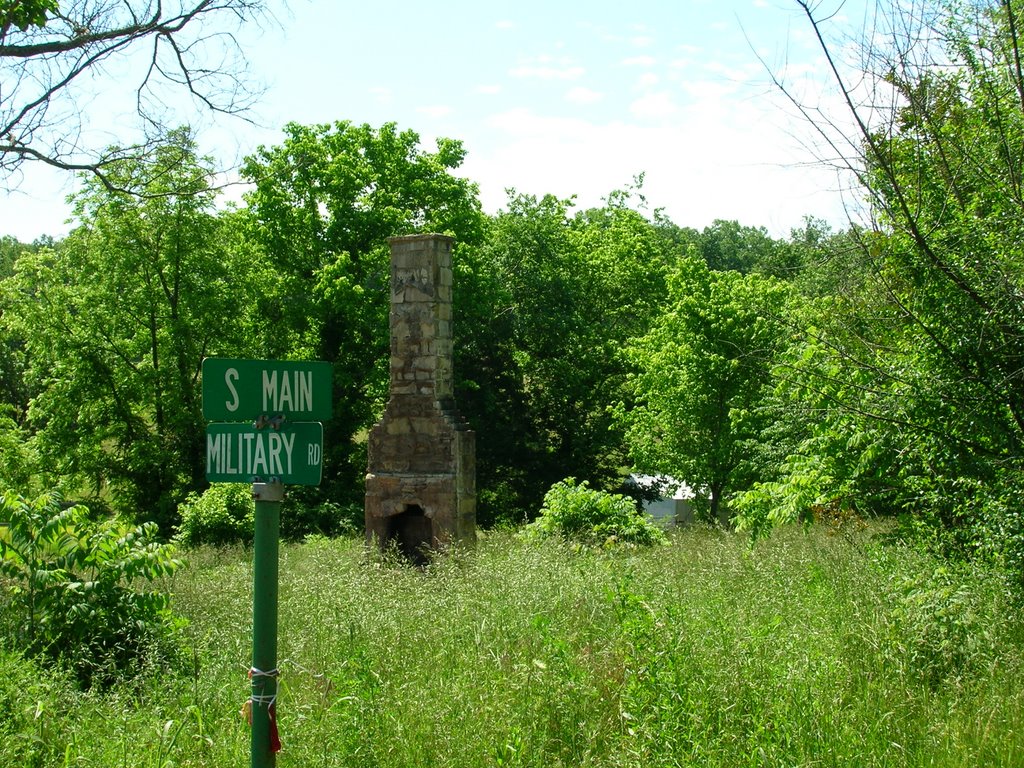
The Old MIlitary Road was used to move native-Americans during the infamous "Trail of Tears". There is an interesting article about the early roads in Arkansas that includes a brief mention of this road which ran from Batesville to Norfork. Here's a map detailing the various routes used to relocate Native Americans. Benge's route is the one that runs through Izard Conty.

Here is paragraph from W.E. McCLeod (1869-1951)

"The other branch of the Military road extended westward from Jackson to Northfork and on to Batesville and Ft. Smith. This was a road used ln the removal ot the Indians to the west, and by immigrants into Northwest Arkansas. It is another road called the Military road, though it was only a branch of the main road, What a wondertul story these old roads could tell if they could speak. It would be a story of silent, sorrowful Indians as they treked their way to a land they knew not, and of thousands of hope- tul immigrants as they wended their way in canvas covered, ox drawn wa- gons, on horseback and on foot to make new homes in the south and west. The roads described were great immigrant routes, particularly in northeast Arkansas; but there were several others a little later which were important in the settlement and development of this section of the state. Soon after 1836 a road was opened from Izard county eastward through Lawrence County, (then including Sharp) to Greene county, This road went by the new towns of Smithville and Powhatan, where there was a fine ferry across Black River. Smithville was and is situated on this road where it intersected the branch of the Military mentioned above, and its favorable location accounts for its continuance to this day as one of the best off railroad towns in the country, The two roads are now graveled highways."

I'll have some shots of the Strawberry River eventually.